
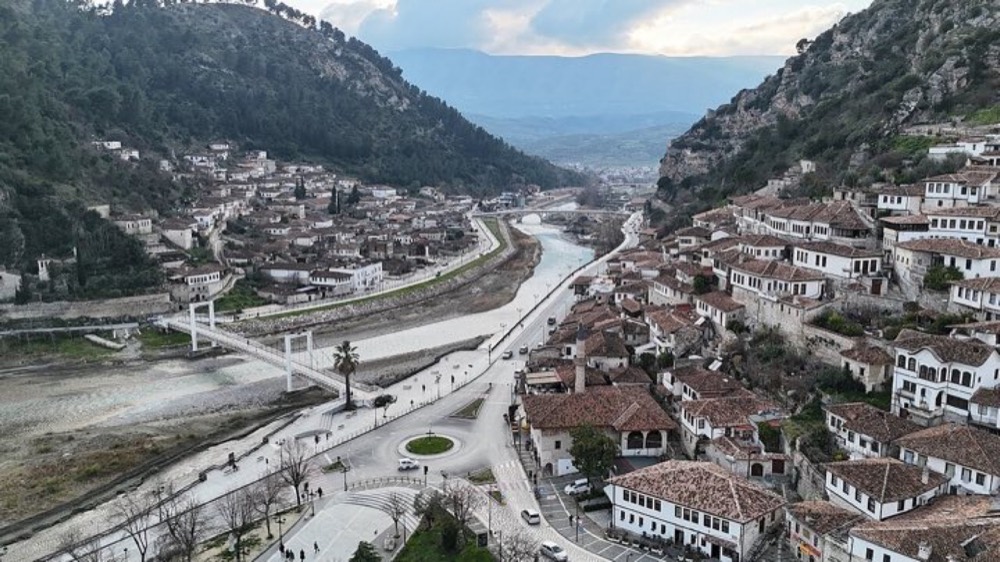
Four centuries under Ottoman rule, and they are not uniform.
Waves of migration carry Albanians to southern Italy, where the Arbëresh preserve a 15th-century Albanian that is still spoken in roughly fifty villages today. At home, conversion to Islam spreads widely, and Bektashi tekkes, a liberal, mystical Sufi order, take root especially in the south.
In the northern highlands the empire never really governs. Those valleys run themselves on the Kanun, an oral customary law older than any sultan.
In 1555 a Catholic priest named Gjon Buzuku prints the Meshari, the first book in Albanian. In the 1700s Voskopojë becomes one of the largest and richest towns in the Balkans, with an academy and one of the region's earliest printing presses. From 1788 Ali Pasha of Tepelena rules a near-independent state from Ioannina.
Key points
| 1555 | Meshari, the first printed book in Albanian |
| Highlands | The Kanun governs where the empire cannot reach |
| 18th c. | Voskopojë, academy, printing press, regional wealth |
| 1788-1822 | Ali Pasha of Tepelena rules a near-independent Ioannina |
Research by ARBËR, the Living Museum of Albania. Published facts are verified or presented as open debate.