
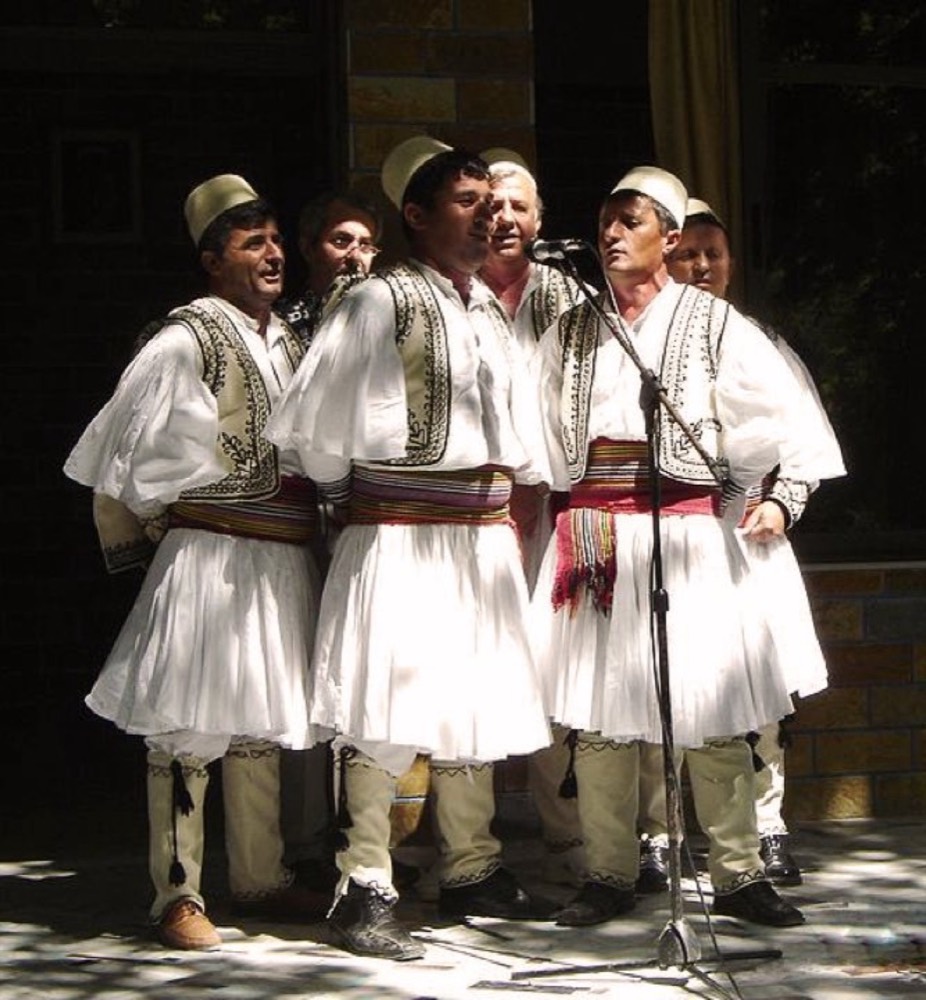
Iso-polyphony
Southern group singing built on a drone held under two moving voices. A marrës (taker) begins the melody, a prerës (cutter) answers, and behind them the rest hold a single unbroken iso.
Proclaimed a UNESCO Masterpiece of the Oral and Intangible Heritage in 2005, and inscribed on the Representative List in 2008 when the Masterpieces were transferred. Most websites give one date and get it half-wrong, see Editorial Standards.
The northern epic
In the north the form is narrative instead: the Kângë Kreshnikësh, epic cycles running hundreds of lines, sung to the one-stringed Lahutë. In the 1930s Milman Parry and Albert Lord recorded singers in this region to test how the Homeric poems might have been composed, the research that reshaped classical scholarship.
Instruments and forms
Çifteli (two strings) · fyell · gajde · the urban serenata korçare of Korçë · valle circle dances, including the K'cimi of Tropojë (UNESCO 2024).
Research by ARBËR, the Living Museum of Albania. Published facts are verified or presented as open debate.